ContainerDays x AI Context 2026: What You Might Have Missed
We just got home from ContainerDays x AI Context Singapore 2026, and we’ve had a few days to let it marinate. It was the first time ContainerDays has come to Singapore, and because it was co-located with AI Context, the crowd was a mix of platform engineers, DevOps practitioners, security teams, and AI engineers building agentic systems.
I’ll come out and say it, this was the first conference I’ve attended in over 10 years of working in software (weird, I know). So these are the takeaways from someone seeing it all with fresh eyes. If you couldn’t make it, here’s what stood out, what it means for teams running Kubernetes, and a few talks worth catching up on.
What we saw in Singapore
AI and platform engineering are becoming one conversation
The clearest signal came from the format itself. ContainerDays covered the familiar cloud native ground of Kubernetes, platform engineering, operations, security, and developer experience. AI Context brought in sessions on AI infrastructure, MCP, agents, governance, and what it actually takes to run these systems in production. Putting both in the same building meant the hallway conversations were incredibly interesting. People were approaching the same problems from different directions, but usually meeting somewhere around infrastructure, developer experience, and how to validate software (and as a result, AI) safely.
The agenda told the same story. Kelsey Hightower joined Geet Bhanawat from Singtel for a fireside chat moderated by AI Singapore’s James Kok, then came back the next day for an off-the-record session with a small group of attendees. Carl Ross from OpenAI gave a talk called When Tokens Stop Being the Bottleneck: Operating Agentic Software Factories, and that title alone sums up a lot of the event, once generating code is cheap, the hard part becomes operating everything around it. If you want background on the software factory idea, Gergely Orosz’s write-up of OpenAI’s agentic software factory in The Pragmatic Engineer is a good primer.
Saiyam Pathak from vCluster asked Will everyone build an AI factory? and answered with a live demo. He went from a single GPU on a personal computer to an enterprise-style setup where multiple teams ran their own isolated Kubernetes clusters and inference workloads on the same GPU, using open source projects like vCluster and HAMi. His point was that an AI factory isn’t just a pile of GPUs. It’s a software platform, with Kubernetes handling orchestration and GPU sharing stretching limited capacity across more teams. That’s a platform engineering problem, which is exactly why it belonged on a ContainerDays stage.
My take is that AI is no longer sitting off to the side of infrastructure. The question for platform teams isn’t whether to support agents, it’s what happens to our platforms when a growing share of code, pull requests, and operational changes come from them rather than from people.
The bottleneck is moving from writing code to validating it
This was the theme I heard most, and it came up in almost every conversation we had at the booth. AI agents were usually described as a multiplier for the good and the bad of existing workflows. AI can speed up writing code, but it doesn’t remove the need to verify and validate that code in a realistic environment.
In some ways, it makes that need more urgent. More generated changes mean more pull requests, more tests, and more versions of services that need to run at the same time. The bottleneck has now shifted. Writing the first version becomes faster, while getting trustworthy feedback from the system around it becomes the slow part.
We spoke with everyone from teams of 3 developers to an enterprise managing over 1,500 software engineers, and whether someone was working on Kubernetes platforms, internal developer tooling, or agentic workflows, they kept coming back to the same few questions, access to real dependencies, isolation between users, infrastructure cost, and how quickly a change can be proven safe.
My take is that faster code generation without faster validation just moves the queue somewhere else. The teams that get the most out of agents will be the ones that invest in giving that code somewhere realistic to run, not the ones that generate the most of it.
Pragmatism beat the hype
What I appreciated most was that the event stayed grounded. There was plenty of excitement around AI, but the talks and hallway conversations kept coming back to practical concerns like cost, isolation, security, reliability, and how teams operate these systems without creating more work than they remove.
The agenda backed this up. By Jimmy Song’s rough count, 22 of the 64 sessions had titles about agents and tooling, covering things like sandboxes for coding agents, fine-grained authorization for MCP tools, and how teams run evals. The MCP sessions were about running it safely rather than showing it off, with talks on AI-driven Kubernetes operations, OAuth2 tool-level authorization on MCP servers, safety primitives for database MCP servers, and a reference architecture for governing MCP, A2A, and LLM traffic on Kubernetes. Day two of AI Context had a track on governance and security (identity, permissions, evaluation, and audit for agents in production), followed by case studies from APAC teams on what shipped, what broke, and what they changed.
Cost got the same honest treatment. One talk on GPU utilization cited surveys putting it mostly between 5% and 20%, with workloads queuing for GPUs while the ones already allocated sat underused. Nobody needed convincing that AI is useful, I think we all agreed that it was. The conversation was more about not wasting money on it.
My thoughts are that this felt like a sign of where the industry is at. The “can we do this with AI?” phase is giving way to “can we run this safely, and can we afford it?”, and that’s a much more useful conversation for platform teams to be having.
Preview environments, everyone wants preview environments, but few actually have them figured out
This is the area I spent the most time on, since it was the topic of my talk. There are three common ways to give a pull request somewhere isolated to run which include full-stack copies, virtual clusters, and session-routed previews on a shared cluster. They make very different trade-offs around cost, startup time, fidelity to production, and operational complexity.
That tradeoff matters even more once agents enter the picture. A developer might open a handful of pull requests in a week. An agent can create several while you’re making a coffee. If every PR needs a full copy of a large application, infrastructure costs and waiting time scale just as quickly as code generation does.
What surprised me was how uneven adoption is. The questions after my talk covered the full spectrum, from people who didn’t know preview environments existed, to people who didn’t know there were multiple ways to architect them, to people using them daily. Several folks also asked how stateful infrastructure like databases is handled, so that writes from a preview never land in production data. I expect that question to get a lot louder once agents are the ones opening PRs.
My impression is that preview environments are moving from nice-to-have to necessary for any team letting agents near their codebase, and the architecture you pick will matter more than whether you have them at all. If you want a deeper comparison of the three models, we recently published a guide to Kubernetes preview environment tools.
Talks worth catching up on
A few sessions worth reading up on:
- Will everyone build an AI Factory? by Saiyam Pathak (vCluster): a live demo of multiple teams sharing a single GPU through isolated clusters. The HAMi team’s ContainerDays Singapore recap covers it, along with their own sessions on GPU sharing and utilization.
- From Zero to Shared GPUs by Jimmy Song and Reza Jelveh (Dynamia): a hands-on GPU scheduling workshop. Jimmy’s write-up is an honest look at where attendees got stuck, and a good reminder that a demo working for its maintainers doesn’t mean it works for users.
- Kubernetes Preview Environments in the Age of Agents by Cecil Singh (MetalBear): the three preview environment models compared, with a live demo of an agent opening a PR. The preview environment tools guide covers the same ground in more depth.
What was MetalBear up to
Here’s what we were doing at the conference.
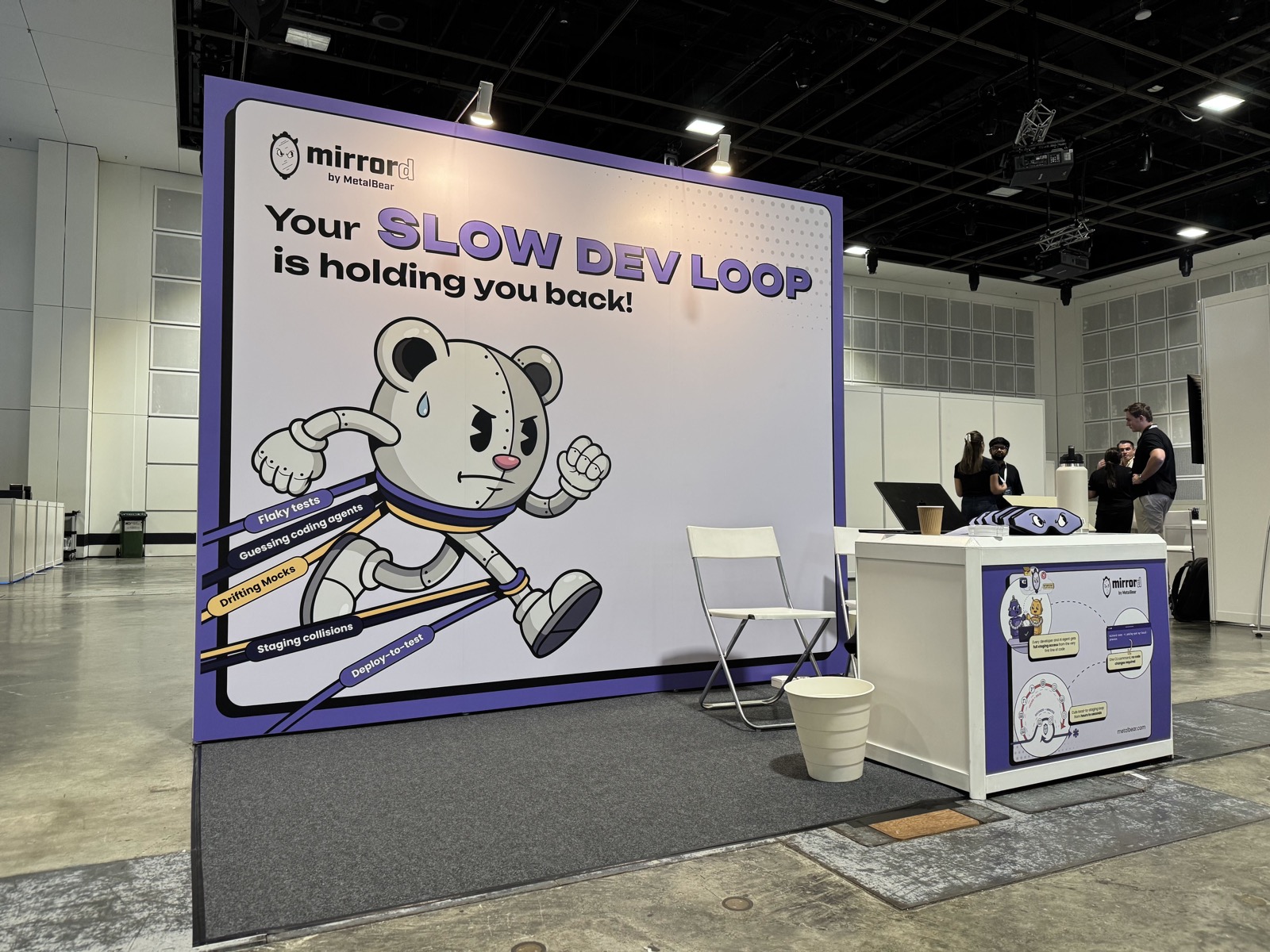
A lot of people were drawn to our booth slogan, your slow dev loop is holding you back. It was a great way to start conversations about how mirrord approaches development and testing against a real cluster, and it was rewarding to watch people have a lightbulb moment about how it would work on their own infrastructure. Many arrived with a specific architecture or workflow in mind and stayed to work through how mirrord would fit into it. Day one was especially busy, while day two slowed down slightly (most likely because the Singapore Week of Innovation and Technology, or SWITCH, was on at the same time).
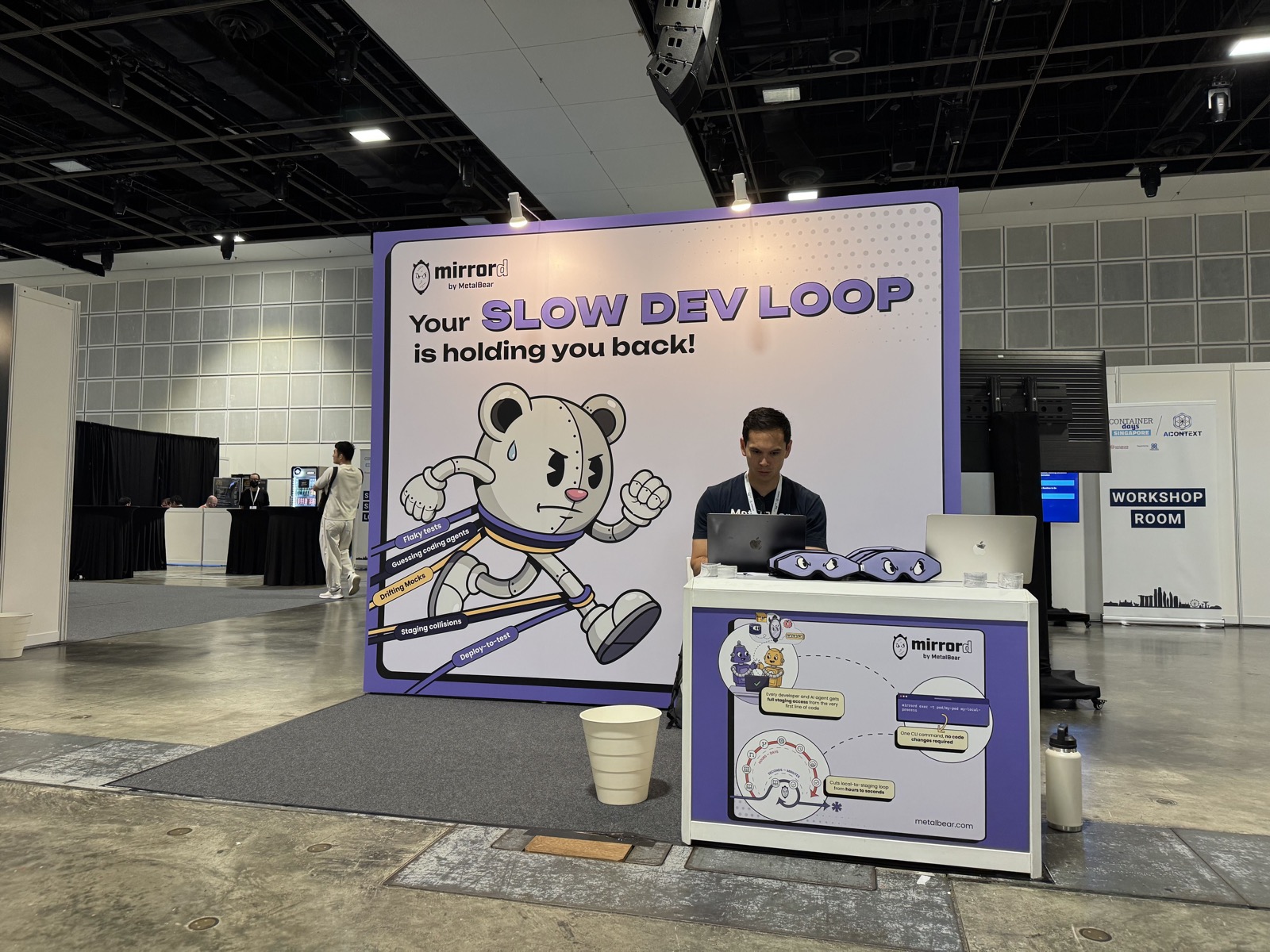
The merch was a huge hit. Our stickers and eye masks cleared out very quickly, and plenty of people came back after we’d run out asking for more. One unexpected highlight was how many compliments we got on MetalBear’s art style. It turns out bold colours and bears are a pretty effective conversation starter at a cloud native conference. Curious about why we’re called MetalBear? Come and find us at a conference and we’ll tell you.

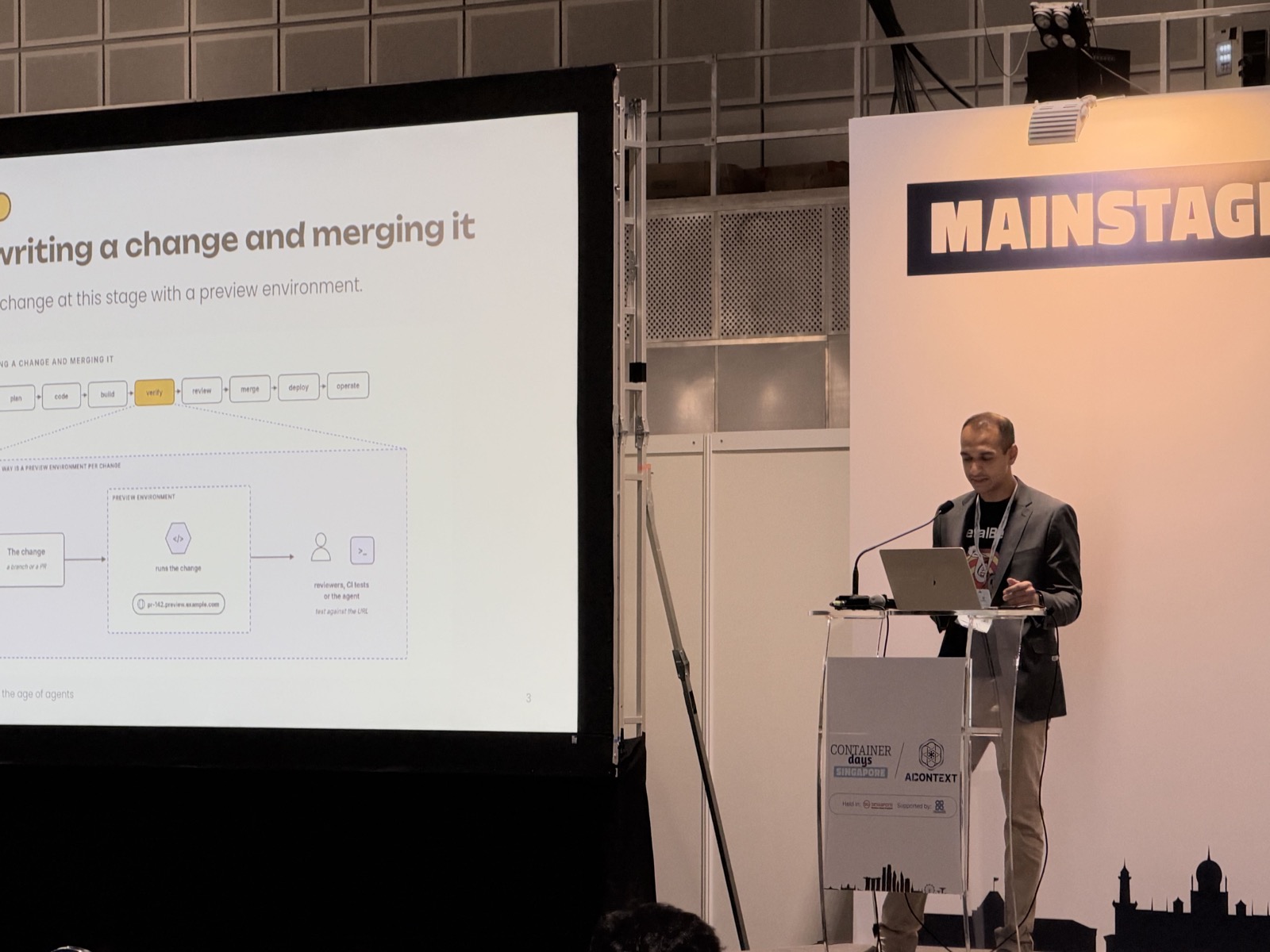
I also gave a talk, Kubernetes Preview Environments in the Age of Agents, comparing the three preview environment models above. For the demo, I built a Codex skill that made a code change and opened a pull request against our playground application. Once the preview was ready, production and the preview ran side by side, each routed to its own session while sharing the baseline services already in the cluster. Closing the PR removed the preview and left everything else in place. Live demos always add a bit of danger, especially with CI involved, but it behaved itself (despite some AV issues at the start). The best result came afterwards, when an attendee who had never used preview environments asked for a proper demo on their own environment. You can also see how mirrord Preview Environments run changed services against an existing shared cluster.
Wrapping up
For a first Singapore edition, ContainerDays x AI Context brought the right communities into the same room. It was small enough that conversations could go deep, but broad enough that we met people working across cloud native infrastructure, platform engineering, and AI. The common thread was clear: AI is making code faster to write, and the hard part is now proving that code is safe to ship.
That’s exactly where mirrord fits. Developers and agents should be able to test changes against a real environment without deploying over one another or duplicating an entire stack for every branch. If your team is waiting on CI or fighting over a shared staging environment just to test a change, you might want to check out mirrord.
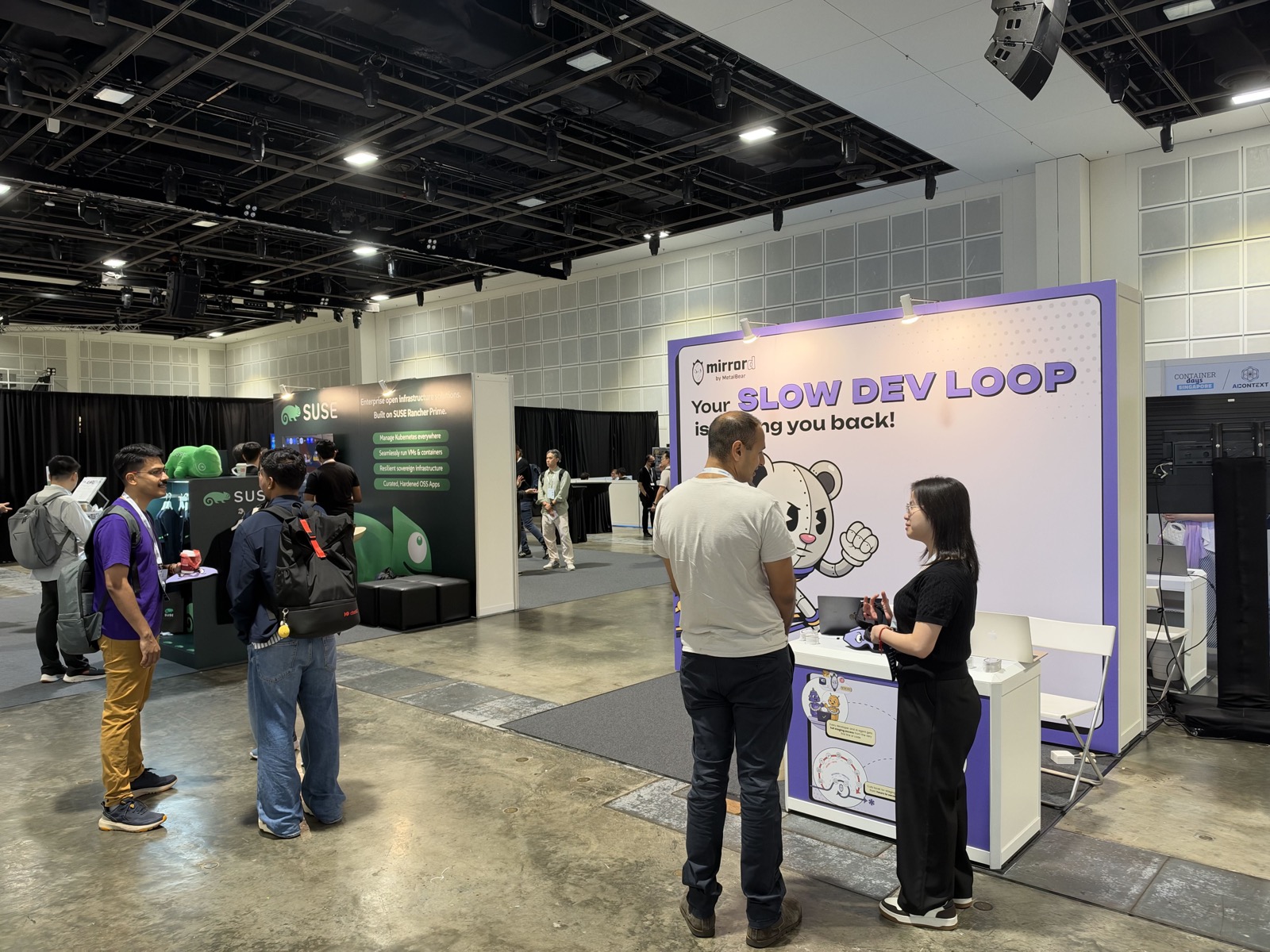
Thanks to everyone who stopped by the booth, came to the talk, asked difficult questions, or just told us they liked the bears. And thanks to the ContainerDays team for bringing the event to Singapore. Hopefully we’ll see many of you again at the next one.
What is mirrord?
mirrord is a Kubernetes development platform that lets developers and AI coding agents test code in a production-like environment before deploying it. Your service runs wherever you're working, locally, in CI, or in an agent's sandbox, while mirrord proxies its traffic, environment variables, and files to and from a shared staging cluster, so it behaves as if it were deployed without actually being deployed.
Engineering teams at companies like monday.com, National Australia Bank, and SurveyMonkey use mirrord to iterate and ship faster, while spending less on dev environment infrastructure.