5 Talks at KubeCon Japan I'm Looking Forward To
KubeCon + CloudNativeCon Japan is back for its second year, this time in Yokohama, after last year’s Tokyo edition sold out with 1,500 attendees. It’ll be my first time attending, and in my excitement I’ve already combed through the entire schedule in detail. There are some genuinely interesting talks lined up, and in this blog I’ll share five that I’m particularly excited about.
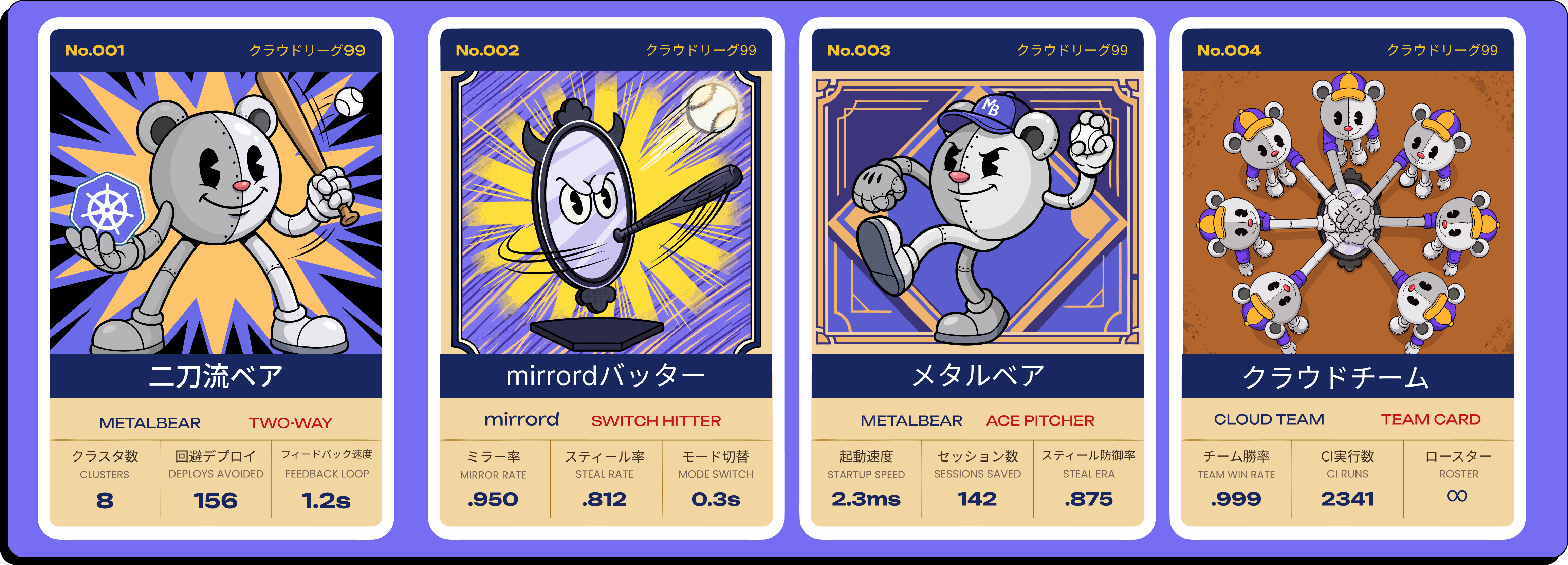
You’ll find us at the MetalBear booth (SU9) at KubeCon. If you’re using AI agents to generate code, you’re probably struggling with reviewing and testing all of it fast enough. We’ll show you how mirrord lets you not only test AI-generated code in production-like environments yourself, but also run autonomous agents that test their own code against a live Kubernetes cluster and iterate until it’s validated. And if that isn’t exciting enough, we’ll also have MetalBear-themed baseball cards for you to collect!
Taming Billions of Rows: Data Lifecycle Management Lessons from a Cloud-Native Database Migration
Speaker: Ruslan Kadyrov (Mercari Inc.)
Jul 29 • 15:50–16:20 · 4F | 414+415
Anyone who’s ever watched a database bill creep up every quarter knows that data doesn’t really go away, it just keeps piling up. That’s exactly the premise of this talk from our friends at Mercari.
Ruslan’s going to walk through how one of Mercari’s core MySQL tables grew into the billions of rows, and how migrating to TiDB (a cloud-native distributed database) forced the team to confront a problem they hadn’t fully appreciated: old dormant records that nobody was actively using, driving up cost and migration risk.
I’m especially curious about how they drew the line between “data we need to keep accessible” and “data we can quietly archive,” without breaking anything user-facing in the process. If you’re running anything at real scale, data lifecycle management is one of those things that’s easy to ignore until it becomes the most expensive line item on your infra bill, so this feels like a genuinely useful case study rather than just a “look how big our data is” talk.
From 165 Days to 30 Minutes: Breaking Enterprise Silos with Platform Engineering
Speakers: Aoi Nishijima, Moeka Okamura & Kohei Yamamoto (JAL Digital Co., Ltd.)
Jul 29 • 17:10–17:40 · 3F | 315
If there’s one thing we love here at MetalBear, it’s making cloud-native developers productive from Day 1. This talk had a similar goal which is why it caught my eye.
JAL Digital had 4,000 engineers across 500 systems stuck behind 15 departments and 40+ forms just to get a new environment set up, which led to a 165-day lead time. This talk is about how they got that down to 30 minutes, not through a clever platform alone but through an actual cultural shift that involved mixing teams to kill the “us vs. them” dynamic, giving teams autonomy to pick their own tooling (Backstage, in their case), and deliberately going after small, high-friction wins first to build trust.
I like that this is framed as an organizational story as much as a technical one. Anyone who’s tried to introduce a new tool or workflow into a large, process-heavy org and hit a wall of forms and approvals will probably recognize a lot of this, and I’m looking forward to learning how they pulled it off.
From Chaos to Control: Achieving 70% GPU Cost Reduction Through AI-Native Observability on K8s
Speakers: Disha Babla (AWS) & Dheeraj Kumar (MongoDB)
Jul 30 • 11:30–12:00 · 4F | 414+415
500 GPUs, 65% idle time, and a $6M annual bill. Those numbers were enough to catch my eye and get me interested in learning how the folks at MongoDB got out of this mess.
The talk covers building an AI-native observability stack for GPU workloads to help monitor and reduce spend: OpenTelemetry plus custom GPU instrumentation, NVIDIA DCGM, eBPF-based NCCL tracing, and anomaly detection wired into Kueue. If that sounds complicated don’t worry because the speakers are promising to open-source the whole thing including architecture, configs, dashboards, and a “10 GPU Golden Signals” guide. So even if you’re not running anything close to 500 GPUs, this sounds like one of those talks you walk away from with something you can actually use.
Shared Yet Isolated at Scale: Building Multi-Tenant Inference Platform on Kubernetes
Speakers: Yuto Hiraki (SoftBank Corp.) & Yusuke Tanaka (ITOCHU Techno-Solutions Corporation)
Jul 30 • 14:50–15:20 · 1F | Main Hall
As more teams inside a company start standing up their own LLM inference, you end up with an infrastructure problem: how do you give every team the isolation they need on clusters without blowing up your GPU utilization and your cost per token?
SoftBank and ITOCHU are sharing how they built a self-hosted LLM inference platform that tries to solve exactly that. Some teams just need an API endpoint, others want full administrative control, and according to them Kubernetes namespace isolation doesn’t cleanly cover both. I’m curious to see what they ended up with and what trade-offs they had to make to keep things both isolated and efficient.
Beyond Translation: The Journey of Building the Japanese Kubernetes SIG Docs Community
Speakers: Aoi Takahashi (Recruit Co., Ltd.) & Junya Okabe (Mercari Inc.)
Jul 30 • 11:30–12:00 · 5F | 503
The Kubernetes open-source community is what makes KubeCon possible. This is why I think everyone should try to attend one community-focused talk so that you get to hear from the people contributing.
Kubernetes’ documentation is famously “English-first,” and SIG Docs’ localization effort is how that gap gets bridged. This talk covers the Japanese team’s experience building one of the project’s most active localization communities, including a hands-on roadmap for landing your first PR in the SIG Docs repo. They’ll be talking about keeping up with the upstream docs’ relentless pace, keeping translations technically accurate at scale, and the debates still shaping how the team works.
If you’ve ever wanted to contribute to Kubernetes but didn’t know where to start, or you’re curious what it takes to sustain a localization effort long-term, this is worth your time.
Come Say Hi at KubeCon if You’re Attending!
That’s my shortlist for KubeCon + CloudNativeCon Japan 2026. It’s a good mix of deep technical stories, organizational lessons, and community work. This mix and diversity in talks is one of the reasons I like KubeCons in the first place.
If you’re heading to Yokohama for KubeCon, come say hi at the MetalBear booth (SU9), and let’s chat about mirrord, developer experience, or just nerd out about Kubernetes. Safe travels, and see you at KubeCon!